- EC - Stories That Build the Future
- Posts
- The Engine That Was Built to Burn Anything
The Engine That Was Built to Burn Anything
Why Rudolf Diesel's engine could run on peanut oil in 1900, why a gasoline engine never could, and how the fuel he imagined came back a century after he died.
In our last post, we left a question open. Rudolf Diesel ran his engine on peanut oil at the 1900 Paris World Exposition, and the onlookers reportedly never noticed anything unusual. A gasoline engine could never do that. Pour peanut oil into a gasoline engine and it will not run. Pour gasoline into a diesel engine and you can wreck it.
Same fuel, two engines, opposite results. The reason is the single most important decision Diesel made, and it is the one his name is least associated with.
He did not build an engine that needed a spark to burn its fuel. He built one that used heat alone to light it.

Diesel’s 1897 engine, considered the first working diesel, on display at the Deutsches Museum in Munich. His first machines already hit about 26% efficiency. The steam engines of the day managed barely 10%. (Photo: Chris Thomas, CC BY-SA 3.0, Wikimedia Commons)
Two ways to start a fire
Every piston engine has to solve the same problem: get the fuel to ignite at the exact right moment, thousands of times a minute. There are only two ways to do it.
A gasoline engine uses a spark. Fuel and air are mixed, drawn into the cylinder, squeezed, and then a spark plug lights the mixture like a match to vapor. The fuel has to be volatile, eager to catch. Gasoline is exactly that. Its flash point, the temperature at which it gives off ignitable vapor, is around -43 degrees C. It will light from a spark in freezing cold. That eagerness is the whole design.
Diesel's engine has no spark plug. It starts the fire a completely different way: with pressure.
When you compress a gas, it gets hot. Squeeze air hard enough and fast enough and it will reach several hundred degrees on its own, no flame required. Diesel's engine pulls in air alone, with no fuel in it yet, and crushes it to roughly 500 to 700 degrees C. Only then, at the top of the stroke, is fuel sprayed in. The air is already hot enough to ignite it on contact. The heat does the job the spark plug does in a gasoline engine.
This is called compression ignition, and it changes what the fuel needs to be.
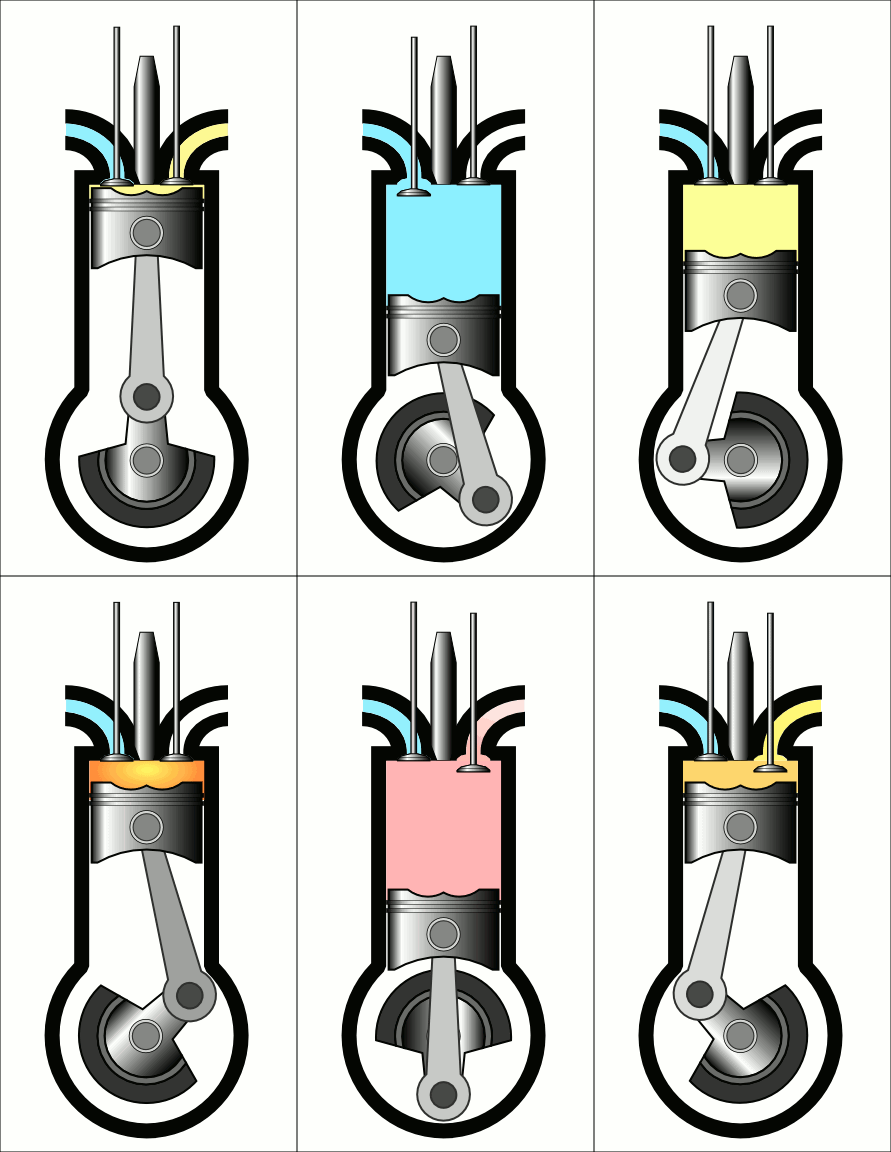
No spark here. The piston just crushes the air until it’s hot enough to light the fuel the moment it’s injected. That is the whole idea. (Animation: Tosaka, CC BY 3.0)
Why gasoline and diesel cannot trade places
A spark engine needs a fuel that ignites easily. A compression engine needs the opposite: a fuel that waits.
In a diesel, you spend the entire compression stroke crushing air without fuel in it. The fuel only arrives at the end. That means the fuel must not ignite early. A heavy, slow-burning, hard-to-vaporize fuel is perfect, because it sits patiently until it is injected into already-hot air and burned in a controlled way.
Now put gasoline in that engine. Gasoline cannot wait. Under the enormous compression of a diesel cylinder, it ignites on its own, early, violently, and at the wrong moment, while the piston is still rising. The explosion fights the engine instead of driving it. That uncontrolled early ignition is called knock, and in a high-compression engine it can crack pistons, deform bearings, and snap connecting rods. The same property that makes gasoline ideal for a spark engine, its eagerness to ignite, makes it dangerous in a compression engine.
Run it the other way and nothing dramatic happens. Diesel fuel in a spark engine mostly just refuses to light. Its flash point is above 52 degrees C. The spark plug cannot vaporize it well enough to burn. The engine sputters and quits.
So the two fuels are not interchangeable, and it is not a small detail. It is the core of each design. The spark engine is built around a fuel that is desperate to ignite. The compression engine is built around a fuel that holds its breath.
Why this let Diesel burn almost anything
This tolerance is what let Diesel burn peanut oil. Because a compression engine wants a heavy, slow-burning fuel, it is far less fussy about which heavy, slow-burning fuel you give it. It does not need a precisely refined, volatile distillate. It needs something oily that will ignite under heat and pressure and burn steadily.
Vegetable oils fit that description. So does peanut oil. So does kerosene, coal tar creosote, and the heavy fractions of crude. Diesel's own engine records list a remarkable range of fuels it was run on, from petroleum distillates to peanut oil to mains gas. The engine did not care about the source. It cared about the behavior: slow to ignite, energy-dense, burns under compression.
That is why, at the French government's request in 1900, his engine could run on peanut oil in front of a crowd that reportedly noticed nothing. The government was thinking about its African colonies, places with no coal and no oilfields but plenty of farmland. An engine that ran on locally grown crop oil was a tool for energy independence. Diesel saw the same thing. In a 1912 speech he predicted vegetable oils as fuel might one day become as important as petroleum.
The efficiency that made it worth the trouble
Compression ignition is harder to engineer than a spark. You need high-pressure injection, you need to time the spray to a fraction of a degree of crank rotation, and you need an engine strong enough to survive the pressures. Diesel spent years on it. So why bother?
Because compression is also where the efficiency lives. The harder you compress the air before combustion, the more of the fuel's energy you can convert into work rather than waste as heat. A spark engine cannot compress very hard, because its fuel would knock. A compression engine is built to compress hard. That is its entire premise.
This is why Diesel's 1897 engine reached about 26% thermal efficiency when the best steam engines of the day were near 10%. It is the same reason diesel engines still get better mileage than gasoline engines today. And it is the reason the ceiling keeps rising: a modern heavy-duty diesel in the US Department of Energy's SuperTruck program has reached around 55% brake thermal efficiency, a number that would have looked like fantasy in 1897.
The high compression ratio that lets the engine burn peanut oil is the same high compression ratio that makes it efficient. The fuel flexibility and the efficiency are not two features. They are the same design decision seen from two angles.

A rapeseed field. This is where biodiesel starts. Fuel grown from a plant like this is closer to what Diesel built his engine to burn than the diesel sitting in the pump today. (Photo: Vincent van Zeijst, CC BY 3.0, Wikimedia Commons)
The vision that came back
For most of the twentieth century, Diesel's fuel vision lost. Petroleum refiners found that a cheap, heavy byproduct of distilling crude oil behaved beautifully in a compression engine. It was slow to ignite, energy-dense, and far easier to store and transport than crop oil that could spoil. We named that byproduct after the engine: diesel fuel. The engine built to free people from oil became one of the largest reasons to drill for it.
But the engine never lost the ability to burn crop oil. That capability was baked into the physics of compression ignition the whole time, waiting. When concerns about emissions and energy security returned at the end of the century, engineers reached back for exactly what Diesel demonstrated in 1900. Modern biodiesel, made from vegetable oils and animal fats, runs in ordinary diesel engines with no hardware changes at common blend levels. The United States alone produced nearly 2 billion gallons of it in 2020.
The fuel growing in a field is closer to what Rudolf Diesel actually built than the fuel at the pump. He just had to wait a century, and he did not get to see it.
That is the quiet tragedy under the famous mystery. The story everyone tells is about how he died: the unslept bed, the coat folded on the rail, the headlines reaching for murder. The story worth telling is what he understood. He built an engine around heat instead of a spark. Because it ignites fuel by compression rather than a spark, it can run on heavy, slow-burning fuels of almost any origin, including the biofuels that came into use a century later.
Got a story worth telling?
Engineers, scientists, and builders - if you've been part of something that changed the game, we want to hear about it. If it's a fit, we'll share it with 324,000 readers who live for this stuff.